Indiana Court of Appeals Affirms New Trial for Notre Dame Exoneration Justice Clinic Client Jason Hubbell
Arienne Calingo · 18 September 2026
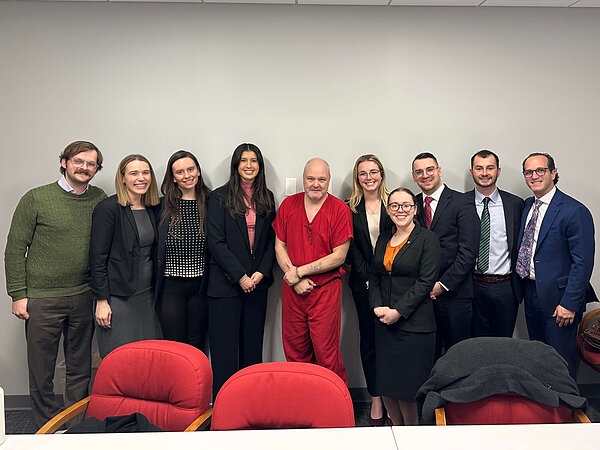
The Indiana Court of Appeals has affirmed a lower court ruling granting Jason Hubell a new trial, a client of the Notre Dame Exoneration Justice Clinic (EJC) who has spent more than 28 years in prison for the 1997 murder of Sharon Myers.
In a September 1 published opinion, the Court of Appeals affirmed Bartholomew County Circuit Court Judge Kelly S. Benjamin’s ruling that the State of Indiana violated Hubbell’s constitutional rights by withholding material exculpatory evidence from his defense. The appellate court explained that the case against Hubbell at his 1999 trial was “not strong” and that the suppressed evidence undermined confidence in Hubbell’s conviction.
“This is a major victory. Jason has been in prison well over 25 years,” said Professor Jimmy Gurulé, faculty director of the Notre Dame Exoneration Justice Clinic. “The critical evidence that the State withheld was evidence that pointed to the actual killer of Sharon Myers. Had that evidence been presented to the jury at trial, Jason wouldn’t have been convicted. What happened to Jason is a tragic miscarriage of justice.”
Hubbell was convicted in 1999 of the 1997 abduction and murder of Myers in Columbus, Indiana, and sentenced to 75 years in prison. The EJC began representing Hubbell on a pro bono basis in October 2022.
In September 2025, Benjamin vacated Hubbell’s conviction and granted him a new trial after finding that the State had violated his constitutional rights under Brady v. Maryland by withholding material exculpatory evidence. The State subsequently appealed the decision.
The withheld evidence implicated Michael Dean Overstreet, who was convicted of the 1997 abduction, rape, and murder of Kelly Eckart and sentenced to death. The murders of Myers and Eckart shared significant similarities. Both women were strangled with ligatures made from their own clothing, and the women were killed within two miles of each other in the Atterbury Wildlife Preserve.
Among the undisclosed evidence were statements from Overstreet’s then-wife that, on the day Myers disappeared, Overstreet left home unusually early in a white cargo van and returned later that evening disheveled and covered in blood. The court also discussed statements from a former co-worker who told investigators that Overstreet had said he was having an affair with a woman named Sharon in Columbus and had gotten her pregnant.
During a five-day evidentiary hearing in February 2025, EJC attorneys and students presented evidence concerning Overstreet’s involvement in Myers’s murder. Hubbell’s original trial counsel testified that, had the undisclosed evidence been available before Hubbell’s trial, he would have investigated Overstreet and presented him to the jury as an alternate suspect.
In its opinion, the Court of Appeals concluded that the evidence withheld by the State was material and exculpatory. The court noted that eyewitnesses described a blond man with Myers shortly before her disappearance, while Hubbell has brown hair. The evidence implicating Overstreet was consistent with a white cargo van seen by eyewitnesses, and pubic hairs near Myers’s body did not match Hubbell.
“As a result of the State’s suppression of the exculpatory evidence, we must conclude that our confidence in Hubbell’s conviction has been undermined,” the appellate court wrote.
Judge Paul Mathias authored the majority opinion, with Judge Mary DeBoer concurring. Judge Dana Kenworthy concurred in the result in a separate opinion, agreeing that the State failed to disclose exculpatory evidence, that the evidence was material, and that Hubbell should receive a new trial.
EJC staff attorney and term teaching professor Kevin Murphy ’14 J.D. led the investigation and litigation of Hubbell’s case, with critical assistance from EJC legal assistant Anne Peterson ’93, ’02 J.D.; EJC staff attorney Lenora Popken ’20 J.D.; adjunct professor of law Elliot Slosar; and EJC investigator Christian Sheckler. Alex Ragland ‘26 J.D., Autumn Chassie ‘26 J.D., current second-year law student Aaron Qiao, and Notre Dame undergraduate student Victor Kaminski all assisted with preparing the briefing on appeal.
Sarah P. Hogarth ’15 J.D. and other attorneys at McDermott Will & Schulte provided invaluable assistance to the EJC with the appeal. The Court of Appeals opinion lists Gurulé, Murphy, Popken, and Hogarth as attorneys for Hubbell.
Since its founding, the EJC has remained committed to criminal justice reform, litigating wrongful conviction cases, and educating the public about miscarriages of justice.
Learn more about the Notre Dame Exoneration Justice Clinic at exoneration.nd.edu.
Originally published by Notre Dame Law School on 18 September 2026