Lucy Letby: Serial killer or a miscarriage of justice?
Sarah Knapton, Martin Evans, Sophie Barnes and Will Bolton · 9 July 2024

When Lucy Letby was convicted of the murders of seven newborns and the attempted murders of six more in August 2023 she was described by the judge as having led a “cruel, calculating and cynical campaign of child murder”.
The detectives who led the case said Letby had operated in plain sight and had abused the trust placed in her in the most unthinkable way.
No one could comprehend what had led a nurse with a previously unblemished career to embark on a campaign of such unimaginable horror, attacking and killing the most vulnerable members of society.
In July 2024, Letby was convicted of another attempted murder – a charge on which the original jury had been unable to reach a verdict – confirming her status as Britain’s most prolific baby serial killer.
But despite the guilty verdicts and the fact her application to appeal was roundly rejected by judges in May, troubling questions started to emerge about some of the scientific evidence used to convict Letby.
After the trial, numerous blogs and armchair detectives suggested she could be innocent in interventions which were largely dismissed as conspiracy theories.
The grieving families of the victims spoke of their anguish that anyone would question the verdict or show sympathy to Letby.
However, experts from universities including Edinburgh, Harvard and Bristol, and members of the Royal Statistical Society (RSS) questioned the way crucial evidence was presented in court.
One of the scientists whose paper was cited in the original case suggested that his work was misinterpreted.
Others went as far as to suggest that, rather than being a calculating killer, Letby was a victim of NHS failings.
Here, The Telegraph examines the scientific concerns in the arguments used to convict Letby.
A damning shift pattern
One of the most damning pieces of evidence presented to the jury was a chart revealing that Letby was always on duty at the Countess of Chester Hospital when babies collapsed or died.
The table, which covered a 13-month period between June 2015 and June 2016, showed that each of the 38 other nurses was in attendance on just a handful of occasions when suspicious incidents occurred.
In contrast, a seemingly conclusive stark black line of dots placed Letby at the scene of all the incidents. Opening the prosecution’s case Nick Johnson KC said that “by a process of simple elimination” only one person could be responsible.
Dr Alexander Coward, a former maths lecturer at the University of Oxford and University of California Berkeley, who reviewed the case, said: “At first glance it’s like ‘Oh my God, at the times all the babies died, Lucy Letby is right there’.
“If that was all the data it would be pretty compelling. You’d say something fishy is going on.”
Yet experts say there are major problems in this approach. To begin with, it is unsurprising that Letby is present on all these occasions given that these are the cases for which she is under investigation.
The chart excludes deaths and collapses which occurred at the neonatal unit when she was either not present or where there was little evidence to suggest she was responsible.
Read the full investigation at The Telegraph.
How the chart makes itself
The Telegraph’s investigation quotes Dr Coward making a claim that is easy to state and hard to believe until you see it: “You could make a chart like that for any nurse in any hospital.”
So we made one. The diagram below is built from invented ward data — 25 nurses, 20 deaths and collapses, generated at random, containing no wrongdoing whatsoever. The only thing written into the simulation is that two of the nurses work more shifts than their colleagues, as Letby did: she volunteered for overtime and, in the spring of 2015, gained the intensive care qualification that let her look after the sickest babies on the unit.
The first panel shows the whole ward. Nobody stands out. The second keeps only those incidents one nurse happened to attend, and her row becomes an unbroken line of dots. The third does the same for a different nurse, and the line follows her instead.
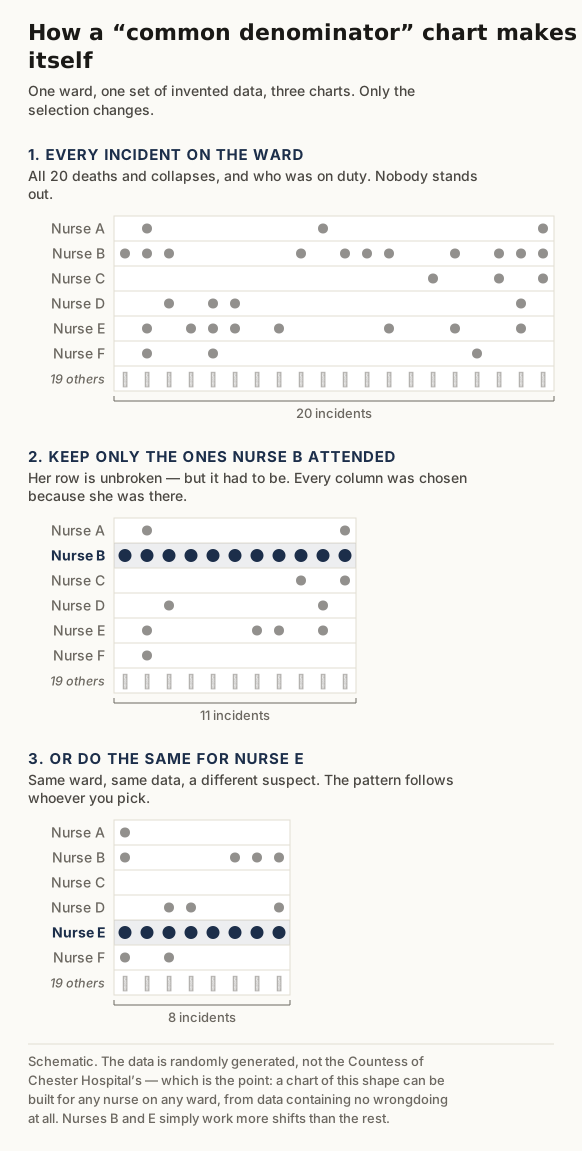
Diagram: False Allegations Hub. The data is randomly generated and is not the Countess of Chester Hospital’s.
The line of dots is not a discovery about the nurse. It is a property of how the chart was drawn: every column was selected because she was there, so her attendance at all of them is guaranteed before any evidence is weighed. A chart built this way cannot come out any other way, which is precisely why it cannot tell you whether anything happened.
None of this establishes that Lucy Letby is innocent, and the full Telegraph piece — which goes on to examine the air embolism theory, the insulin tests and the state of the unit — reaches no such conclusion either. It establishes something narrower and more troubling: that one of the most persuasive exhibits the jury saw would look identical on a ward where nothing at all had gone wrong.
Originally published by The Telegraph on 9 July 2024