Marvin Anderson: 210 years, and a lab notebook nobody threw away
False Allegations Hub · 3 November 2026
In July 1982 a young woman in Hanover County, Virginia was raped by a stranger. A police officer suspected Marvin Anderson, then 18, for one reason: the attacker had said he “had a white girl”, and Anderson was the only Black man the officer knew of who lived with a white woman. He had no criminal record and so no mugshot, so the officer used his colour employment ID photo.
The victim was shown that colour photograph alongside six black-and-white mugshots, and picked him. An hour later she viewed a live lineup in which Anderson was the only person whose photo had appeared in the array. She picked him again. An all-white jury convicted him on all counts and he was sentenced to 210 years.
What makes it significant
Three things, each of which should have ended the case.
The bicycle. The attacker rode a bicycle, and its owner was prepared to say that John Otis Lincoln had taken it about half an hour before the rape. Anderson asked his lawyers to call the owner and Lincoln as witnesses. They declined.
The confession. In 1988, Lincoln came forward and admitted the crime under oath at a hearing. The trial judge refused to vacate the conviction. Anderson stayed in prison for another nine years.
The evidence that should not have existed. Anderson’s lawyers were told the rape kit had been destroyed, and for years that was the end of it. In 2001 the state reported that sperm samples had survived by accident, taped into a criminalist’s lab notebook. Testing them excluded Anderson and matched Lincoln.
He was paroled in 1997 after fifteen years, exonerated in December 2001, and pardoned by Governor Mark Warner on 21 August 2002 — the first Virginian cleared by DNA, and around the ninety-ninth person exonerated by post-conviction DNA testing in the United States. He later became chief of the Hanover Fire Department and now sits on the Innocence Project’s board.
The scale
In the WBNG report transcribed below, Christina Swarns says that of roughly two million people in American prisons, research estimates between one and five per cent are innocent — up to a hundred thousand people.
That range is drawn from the cases where error can be detected at all. The best-evidenced estimate points the same way and further: a 2014 study in the Proceedings of the National Academy of Sciences put the rate of false conviction among American death sentences at at least 4.1 per cent, a figure its authors expressly called conservative, and more than double the 1.6 per cent who had actually been exonerated. Death sentences attract the most intensive post-conviction scrutiny of any category of case. Ordinary convictions, which receive nothing like it, have no reason to be cleaner — only quieter.
Anderson’s case is the illustration. Without a lab notebook nobody had thought to throw away, he would still be a convicted rapist.
The speakers
Marvin Anderson served fifteen years of a 210-year sentence for a rape he did not commit, and four more on parole before his exoneration. Christina Swarns is executive director of the Innocence Project, which took Anderson’s case in 1994, and gave the keynote. Anne Bailey is director of Binghamton University’s Harriet Tubman Center for Freedom and Equity, which hosted the event. Cameron Brown reported the piece for WBNG 12 News.
We have covered the Innocence Project’s work before — see our other coverage.
The report is on WBNG’s website.
This is a transcript of the broadcast report. The views are the speakers’ own. Speaker labels are ours; the studio anchor is addressed as “Jess” but not otherwise named.
The report
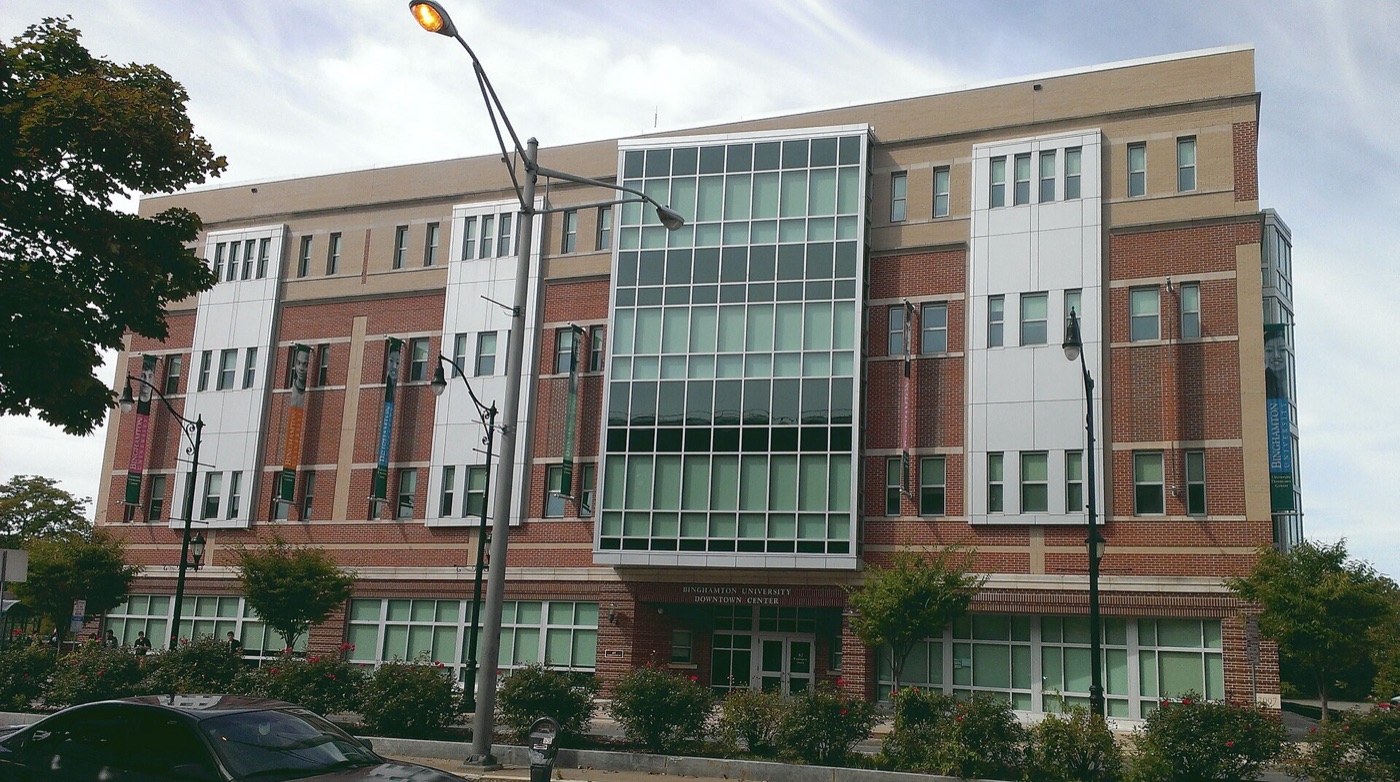
Anchor: Imagine being sentenced to more than two centuries behind bars for a crime you did not commit. That was the reality for one man who spent 20 years fighting for his freedom, and he’s now sharing his story to push for change. Joining us live in studio is 12 News’ Cameron Brown, who was at Binghamton University’s Downtown Center and has more on his call to reform a broken system. Cameron, what did he have to say?
Cameron Brown (reporter): Well Jess, at just 18 years old, Marvin Anderson thought his life was essentially over when he received a 210-year prison sentence. But after decades of struggling to prove his innocence, he’s using that pain to advocate for thousands of others still locked away.
Marvin Anderson: That day in courtroom I was found guilty, the whole room just went dark. I couldn’t see my family — and they were sitting directly behind me — and I just sensed that, you know, my life was over.
Cameron Brown (reporter): And for a while that was the case. Marvin Anderson, who was wrongfully convicted of sexual crimes at the age of 18 by an all-white jury in 1982, was sentenced to 210 years in prison. But thanks to the Innocence Project, an organisation which he is now a part of, he was exonerated after 20 years, and spoke at the Binghamton University Downtown Center on Thursday morning to a crowd about reforming the prison system.
Marvin Anderson: That justice system is broken, and it has been broken for a long, long time. And until we as citizens of this country vote it to make these changes, it will continue to be this way.
Cameron Brown (reporter): Christina Swarns, the executive director at the Innocence Project, delivered the keynote address and said Anderson’s story was just one out of thousands who’ve been wrongfully convicted.
Christina Swarns: The reality of the country that we live in is that we have two million people in prison right now. Research estimates between one and five per cent of those folks that are currently inside are actually innocent. So that means up to a hundred thousand people are behind the wall who did actually nothing wrong.
Cameron Brown (reporter): Which is why Anne Bailey, the director of the Harriet Tubman Center for Freedom and Equity at Binghamton University, had her organisation host the event — because in her eyes, work like this aligns with its values and gives the innocent a second chance.
Anne Bailey: Harriet Tubman in her day left no one behind, and as our inspiration that’s exactly what we’d like to do: to make sure that those who are in the prison system are treated fairly, that there’s a focus on rehabilitation, and that there’s a focus on, when they come out, that they have opportunities — because everybody deserves a second chance.
Cameron Brown (reporter): Organisers say conversations like this are just the first step. The Harriet Tubman Center says it plans to continue working with groups like the Innocence Project to push for meaningful criminal justice reforms, both locally and across the nation. Live in studio, Cameron Brown, 12 News.
Originally published by WBNG 12 News on 30 October 2026